Posts in Photography

Nichols announces campaign for re-election

June 25th, 2021 Posted by fromthetrail, Photography 0 thoughts on “Nichols announces campaign for re-election”

Jacksonville, TX – Today, Senator Robert Nichols (R-Jacksonville) announced he will seek re-election to represent Senate District 3 in the Texas Senate. Senate District 3 is comprised of 19 counties covering the greater part of East Texas and Montgomery County.

“It has been the greatest honor of my life to serve as a representative of East Texas and our values in the Senate,” said Senator Nichols. “It’s my hope that the people of SD-3 will allow me to continue to serve them and their interests in the Legislature.”

Senator Nichols was first elected to the Texas Senate in 2006 and has served as the chair of the Senate Committee on Transportation since 2011. Senator Nichols is also the vice chair of the Business and Commerce Committee and serves on Finance, Criminal Justice, Local Government, and Select Redistricting Committees.

“I have always strived to be a strong voice for rural interests and Senate District 3 during my time in the Senate,” said Senator Nichols. “I am humbly asking Texans in my district to continue to give me that honor.”

Before being elected to the Senate, Nichols served as a TxDOT Commissioner for eight years. He was appointed to the commission by then-Governor Bush and reappointed by Governor Rick Perry. Prior to TxDOT, he served on the Jacksonville City Council and later as the mayor. He is married to his high school sweetheart, Donna, with whom he as three children, Brittney, Josh, and Collynn’rae.

###

HOUSE BILL 5, EXPANDING BROADBAND SERVICE, SIGNED BY GOVERNOR ABBOTT

June 15th, 2021 Posted by fromthetrail, Photography 0 thoughts on “HOUSE BILL 5, EXPANDING BROADBAND SERVICE, SIGNED BY GOVERNOR ABBOTT”

HOUSE BILL 5, EXPANDING BROADBAND SERVICE, SIGNED BY GOVERNOR ABBOTT

AUSTIN — Today, Governor Greg Abbott signed House Bill 5 by State Representative Trent Ashby (R-Lufkin) and State Senator Robert Nichols (R-Jacksonville) which will increase access to and adoption of high-speed internet throughout Texas. The measure was deemed by the Governor as one of only eight Emergency Items for the 87th Legislature and received a low bill number, indicating priority status, by both Lieutenant Governor Dan Patrick and Speaker Dade Phelan.

“Thank you to Senator Nichols and Representative Ashby for their leadership on House Bill 5, which will help increase high speed internet access in Texas,” said Governor Abbott. “Broadband is no longer a luxury — it is an essential tool for education, business, and healthcare, which is why I made the expansion of broadband an emergency item this session. HB 5 will help close the digital divide throughout Texas.”

With Governor Abbott’s signature, the provisions in the legislation become effective immediately. The first order of business for the newly created Broadband Development Office will be identifying which areas of Texas have access to broadband and which do not, ultimately defining who will be eligible for state, federal, and philanthropic funding.

“The passage of House Bill 5 requires the state to create and maintain a broadband access map,” said Senator Nichols. “This will identify corners of the state that are lacking broadband. Those areas can receive targeted support and funding to build the infrastructure necessary to deploy broadband. This bill exemplifies Texas’ commitment to developing critical 21st century infrastructure and expanding broadband access.”

One of House Bill 5’s most critical components is the establishment of a state broadband plan to establish long and short term goals that guide the development and investment of broadband infrastructure for all Texans. As one of only six states in the United States without a broadband plan, Texas often finds itself at a disadvantage when applying for federal dollars.

“Without a state plan for broadband, Texas was leaving precious resources on the table,” said Representative Ashby. “House Bill 5 creates this plan to establish goals and guide our state’s investment in broadband. The more we can do to bring the 21st century to rural and underserved communities, the better chance we have at closing the social and economic gap that has widened due to lack of reliable, high-speed internet.

Nichols was first elected to the Texas Senate in 2007 and represents 18 counties across East Texas and part of Montgomery County. Ashby is in his fifth term as a member of the Texas House of Representatives, and currently represents Angelina, Houston, Leon, Madison, San Augustine, and Trinity Counties.

###

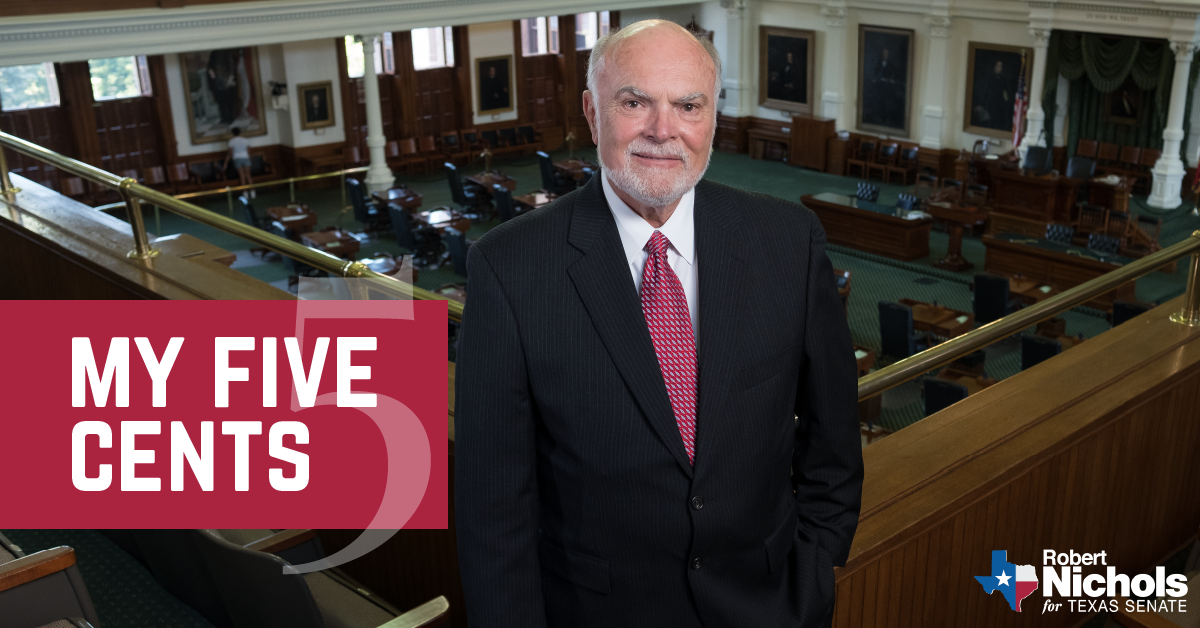
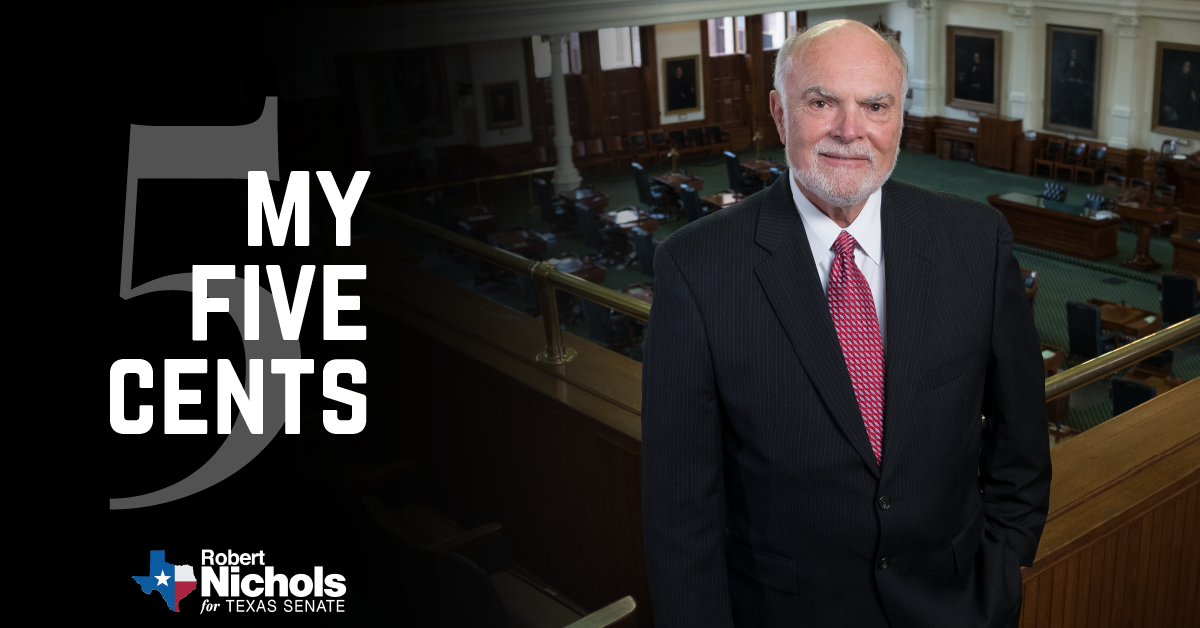
My Five Cents

June 7th, 2021 Posted by fromthetrail, Photography 0 thoughts on “My Five Cents”

By Robert Nichols

With session over, there’s time to reflect on what happened toward the end of session and the new laws the legislature passed over the past 140 days.

Here are five things happening around your state:

1. Legislature adjourns Sine Die

The 87th Legislative session has ended and this week both chambers adjourned Sine Die. In total, the House and Senate filed 7,025 bills combined. Of those, the House filed 4,834 bills and the Senate filed 2,191 bills. However, only 1,081 bills from both the House and Senate were sent to the Governor. Of the bills sent to the Governor, I authored or primarily sponsored 29 of them.

I’m immensely proud of the work we accomplished this session on behalf of the people of East Texas and I look forward to getting back to the district to discuss this session’s accomplishments.

2. Potential special sessions on the horizon

Though the legislature passed a lot of good bills this session, anticipate having at least one, but likely two, special sessions this fall. The Governor announced he will call the legislature back to work on election security and bail reform, two emergency items that didn’t pass this year. The Governor also discussed a line-item veto of Article X of the budget, which funds the legislative branch. If that happens, funding for the Legislature would run out on September 1 and we would need to reconvene before then to re-appropriate those funds.

The most complicated process we’ll undertake this fall is redistricting. The data we need to start the process will arrive by August 16, according to the Census Bureau. The complete data toolkit will arrive sometime before September 30. After that data is received, the process of redrawing district lines for the State House, State Senate, US Congress, and State Board of Education can begin.

3. House Bill 19 aims at curbing trucking litigation

During this session, both chambers passed House Bill 19, authored by Representative Jeff Leach and sponsored by Senator Larry Taylor. The bill is aimed at cutting down on frivolous lawsuits in the trucking industry and other commercial vehicles.

The bill would create a two-step process for litigation. First, the driver of the commercial vehicle would have to be proven liable in court for the accident. After that, the trial could proceed to a second phase where the injured party could bring a case against the driver’s employer. Damages would be assessed at that point. This bill aims to cut down on unjust and excessive lawsuits. I was proud to co-sponsor this bill in the Senate.

4. Multiple bills signed to prevent defunding the police

Governor Abbott signed four bills in the past week that stop cities from defunding the police and enhance penalties for crimes that interfere with police work. Those four bills include:

  • House Bill 9 – authored by Representative Stephanie Klick and sponsored by Senator Donna Campbell. The bill would increase the penalty for knowingly blocking an emergency vehicle or obstructing access to a hospital or health care facility. The penalty would be a state jail felony, which carries up to two years in jail and a fine of up to $10,000.
  • House Bill 1900 – authored by Representative Craig Goldman and sponsored by Senator Joan Huffman. The bill would freeze property tax revenue for larger cities that defund the police while also preventing those cities from annexing new land and allowing areas that had been annexed in the previous 30 years to vote to dis-annex.
  • House Bill 2366 – authored by Representative Brad Buckley and sponsored by Senator Bryan Hughes. This bill enhances penalties for using laser pointers against police or using fireworks to harm or obstruct police.
  • Senate Bill 23 – authored by Senator Joan Huffman and sponsored by Representative Tom Oliverson. This bill would require that in the state’s largest counties, voters would get the opportunity to vote on reductions in law enforcement budgets. If the measure is rejected and the county still reduces funding, the county’s property tax revenue would be frozen.

5. Legislature passes bill to ban teaching tenants of Critical Race Theory

House Bill 3979 was sent to the Governor in the last few weeks of session. This bill requires a diverse list of historical figures and documents for students to study in social studies curriculum. Importantly, this bill also includes a ban on teaching that one race or sex is inherently superior to another or that any individual by virtue of their race or sex is inherently racist, sexist, or oppressive. This important legislation is now heading to the Governor’s desk.

My Five Cents

June 1st, 2021 Posted by fromthetrail, Photography 0 thoughts on “My Five Cents”

By Robert Nichols

The last week of session is coming to a close and the long nights have stretched into the early hours of the following mornings. We’re sprinting to the finish of an unusual session and passing consequential and substantial legislation.

Here are five things happening around your state:

1. Budget Conference Committee Report approved by Senate

In one of the last steps the state budget needs for approval, the Senate passed the final version of the budget this week.

This session’s budget appropriates $248.5 billion in all funds for the 2022-21 biennium.

In all, it maintains our commitments to education we made last session, strengthens public safety and invests in our future, all while practicing fiscal restraint. It includes more than $30 billion to address transportation needs, including $26.5 billion for highway planning, design, construction and maintenance; $3.1 billion to fund enrollment growth for public education; $200 million for Gulf Coast protection and mitigation efforts; $30 million for new rural and urban community mental health beds; and $34 million for pay raises for TDCJ correctional officers at maximum security units, among other priorities.

I’d like to thank Sen. Jane Nelson, Rep. Greg Bonnen, my fellow members of the Senate Finance Committee and the House Appropriations Committee for all the hard work and dedication to putting together a fiscally responsible budget.

2. Broadband Office bill update

This session, Rep. Trent Ashby and I put an emphasis on passing meaningful broadband reform to expand broadband services in our state. This week, the House and Senate Conference Committee convened and we worked out the differences between our two bills to come up with the final product.

House Bill 5 will create the Broadband Development Office within the Comptroller’s office. The office will serve as a resource for information about broadband service and digital connectivity in the state and for federal programs. It also directs the office to create a broadband development map that will identify areas that are not served or are underserved and the percentage of addresses that have access to service. This map is necessary to be eligible for certain federal funds that could help expand broadband access.

Working on this legislation was one of the highlights of this session and one of the most important and impactful bills of session.

3. Texas House approves name, image and likeness bill

In the last few days before its deadline, the Texas House passed Sen. Brandon Creighton’s Senate Bill 1385. This bill would allow student athletes at Texas universities to earn compensation for use of their name, image and likeness for things like promotional appearances and product endorsements, so long as they’re not engaged in official team activities.

Recently, several other states have passed similar legislation after a national movement by student-athletes brought awareness to the issue. Texas would be the 17th state to pass such legislation.

This bill will keep our state institutions of higher education competitive with other schools and states that now allow this practice, especially in terms of recruiting top-tier talent.

4. Freedom to Worship Act passes the Senate

House Bill 1239 passed the Texas Senate late last week. This bill, sponsored by Sen. Angela Paxton, would ensure that houses of worship are protected from being forced to close under any emergency powers in the future.

During the COVID-19 pandemic, certain emergency orders forced churches and other houses of worship to shut their doors. This bill would guarantee Texans’ right to freedom of religion and free exercise of religion, rights that are promised and protected by the First Amendment.

Worship and the community that comes with it are essential to many Texans lives. This legislation recognizes that and ensures that no law, emergency order, local ordinance or other mandate can deny Texans that right.

5. Bill to allow for employer-driven workforce training passes

As the home to 50 Fortune 500 companies and with an economy that would qualify as the ninth largest globally, Texas has an obligation to the businesses that are here and those that move here to provide the best workforce possible.

As such, Sen. Paul Bettencourt sponsored House Bill 4361, which passed the Texas Senate this week. This bill is aimed at ensuring businesses in Texas can find and hire employees who are qualified and have the correct training to work there.

This bill would allow employers to issue a request for proposal to any higher education institution to offer off-campus workforce education or other programs that could count toward college credit.


My Five Cents

May 24th, 2021 Posted by fromthetrail, Photography 0 thoughts on “My Five Cents”

By Robert Nichols

Session is drawing to a close. This is the last week for Senate committees to realistically consider bills to vote out of committee.

We have until Wednesday to vote on any bill on the floor. After that, the Senate can only vote on Conference Committee Reports or concur with House amendments until we adjourn Sine Die on May 31.

Here are five things happening around your state:

1. Gulf Coast Protection District bill passes the House

This week, Senate Bill 1160 was voted off the House floor. The bill creates the Gulf Coast Protection District, which would be a fundamental part of funding the construction of the Coastal Spine Project — also known as the Ike Dike. This large levy system would start in Orange County and eventually extend to protect the Houston Ship Channel.

In the long term, it would extend all the way to Freeport. The Army Corps of Engineers is constructing the project and it’s partially funded by a $4 billion federal appropriation after Hurricane Harvey.

The Gulf Coast Protection District would be the funding mechanism for the state match and would have the authority to sign a project partnership agreement with the Corps for these projects.

This long-term project would be integral to the protection of the Gulf Coast from flooding and hurricanes.

2. Governor opts out of additional federal pandemic unemployment benefits

This week, Gov. Greg Abbott announced Texas will end its participation in the program that allowed unemployed Texans to collect an additional $300 per week since the start of the COVID-19 pandemic.

In recent weeks, there were more than 60% more jobs open in Texas than there were in the weeks leading up to the start of the pandemic. Businesses and business groups like the Texas Association of Business asked the governor to end the additional payments as they were disincentivizing work and many good jobs were left unfilled.

Abbott is one of 20 other governors who also ended their state’s participation in the program.

3. Winter Storm Uri response bill making its way through the House

Senate Bill 3 was voted out of the House Committee on State Affairs this week, bringing it another step closer to passage as law. This bill is largely in response to Winter Storm Uri and the power grid failures during the storm.

Specifically, this bill limits residential customers from signing up for variable-rate plans that left consumers with sky-high electric bills; it requires grid managers and utility regulators to practice for emergencies, including load shedding exercises; it requires power outage alerts; and it requires weatherization of certain parts of the electricity supply chain, including some natural gas production sites.

The bill also establishes the Texas Electricity Supply Chain Security and Mapping Committee, which would map the state’s electricity supply chain to designate priority electricity service needs during extreme weather and sources in the supply chain necessary to operate critical infrastructure.

4. Homeowner’s Religious Freedom Act sent to the governor

The House finally passed Senate Bill 581 by Sen. Paul Bettencourt, also known as the Homeowner’s Religious Freedom Act this week.

This bill would preserve Texans’ rights to free speech and free exercise of religion by preventing property owners’ associations from forcing homeowners to remove any religious displays. This could include crosses, menorahs or Nativity scenes displayed in a homeowner’s yard.

Previously, a POA could have forced a homeowner to take down a religious display if it did not follow often strict guidelines set by the POA. This bill upholds and guarantees the rights promised to Texans in the First Amendment.

5. House Bill 33 passes the Senate, sent to the governor

When veterans retire from active-duty military service, they leave that profession with skills and training that can be transferable to civilian industries. However, currently Texas higher education institutions don’t have a way to evaluate those skills and how they may transfer as post-secondary education credit.

House Bill 33 sponsored by Sen. Judith Zaffirini seeks to address that issue by requiring the Texas Workforce Commission to identify programs offered by career schools or colleges for which skills obtained through military experience, education and training frequently align. TWC then would require schools to provide credit toward any course for the relevant program.

A list of identified programs and approved career schools and colleges will be available on the Texas Higher Education Coordinating Board website. This bill will help our veterans pursue and obtain post-secondary education after they’ve completed their service.

nichols-logo-white

Political Ad. Paid for by Robert Nichols for Texas Senate.

 Privacy Policy

CONTACT

Phone: (903) 586-1200
Fax: (903) 586-7877
Email: info@nicholsforsenate.com

Mailing Address:
P.O. Box 2347
Jacksonville, Texas 75766

Physical Address:
214 East Commerce Street
Jacksonville, Texas 75766

MEET ROBERT NICHOLS

Texas Sen. Robert Nichols is a devoted husband and father who shares our conservative East Texas values. Sen. Nichols cares deeply about Texas and our country.